About Producing Spinach Seed

Spinach is a major small farm crop on Long Island. Typically, it is sown in late summer for fall harvest or fall for an over-wintered spring crop. Raising spinach from a late spring- early summer sowing often results in failure because spinach is very day-length sensitive. It is a LONG DAY plant meaning that instead of producing masses of large leaves, it is compelled to put it's energy into producing flowers when day lengths are getting longer. Our seed harvests are typically just after the summer solstice (June 21).
Some spinach cultivars have been selected for their long-standing or bolt-resistance since one would rather be able to produce and harvest those leaves for as long as you can. Breeders have selected for bolt-resistance by rouging out early bolters. You should do the same
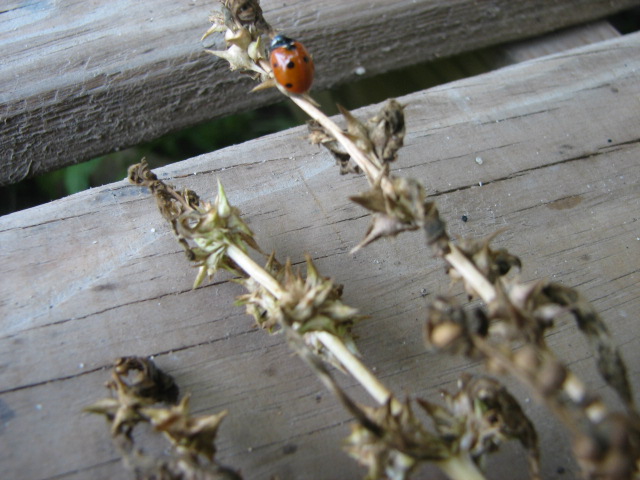
(Prickly-seeded (or sharp-seed) spinach dried on stalk and ready to be stripped (carefully-ouch!) from stalk. Lady bug seems not to be concerned.)
Prickly-Seeded spinach cultivars were common at one time, but not any more. Smooth or round seed is easier to clean and sow. We collected some prickly seed varieties from China, Holland and the Heritage Gardens at Monticello just to see if there were some traits that made them useful in our breeding program. In Jefferson's days prickly varieties were considered the most cold-hardy.
LISEED SPINACH EVALUATION:
Over the years we have been interested in finding a really great tasting spinach. One with a lower metallic oxalic acid taste. In recent years two stand out as very good. Unipack 12, a commercial processing hybrid with it's round, smooth leaves (and good bolt resistance) and Monnopa, an open-pollinated variety from Europe which is well-regarded by organic growers there.
We are participating in the NOFA (Northeast Organic Farmers Association) trial of Butterflay from Turtle Island Seeds this year. Butterflay is a winner in the taste-test. Quick growing and vigorous from an April sowing, it is a quick germinator and in spite of this spring's heat, kept it's fine flavor. In this year's trial it out performed Unipack in our sandy soils and has many similarities with Unipack. It resisted bolting until temperatures reached in the 90's for several days. Cooler weather would have given us a better, extended harvest since cold can suppress bolt proneness. We'll plant it again in late summer to see how it performs in cold.
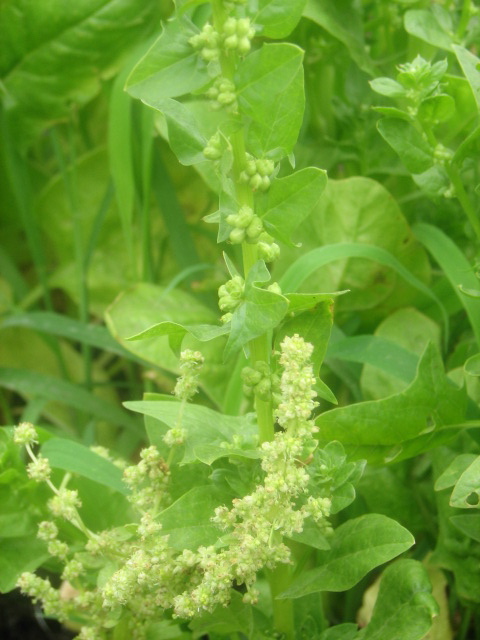
A smooth-seeded type spinach. In most spinach varieties plants are dioecious (there are also monoecious types with both male and female flowers on the same plant stalk). Here the male plant is in the front and the female plant is in the background. Large clustered fruits (containing the immature seed can be seen on the female stalk. The males appear first and shed lots of wind-blown pollen. If you are producing pure seed of a variety make sure that there aren't any other varieties shedding pollen for at least several thousand feet. It is easy to develop your own designer hybrid though by intercropping two varieties. The males will wither and die leaving the often taller, more robust female plants to mature their seeds.
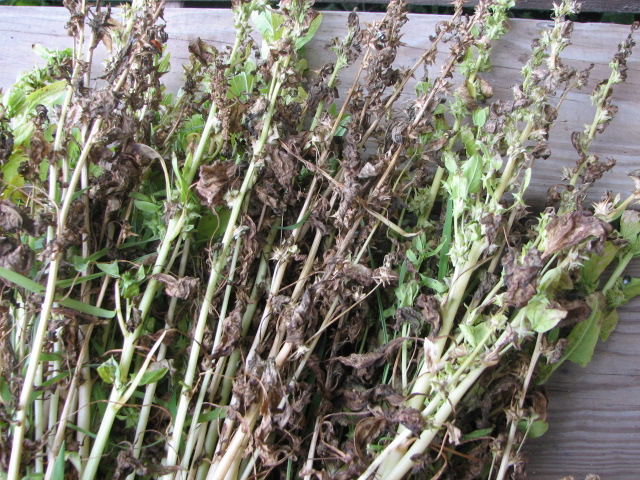
Female spinach plants pulled out of the ground with roots and seen here, drying until all the stalks are brown and brittle. Even though some stalks are still green we choose to harvest the entire seed crop when most of the stalks are brown and some of the seeds begin to shatter (drop from the stalks).
Butterflay is available from Turtle Tree Seeds, Camphill Village, Copake, NY 12516
Water Spinach
(Ipomoea aquatica, Family: Convolvulaceae)
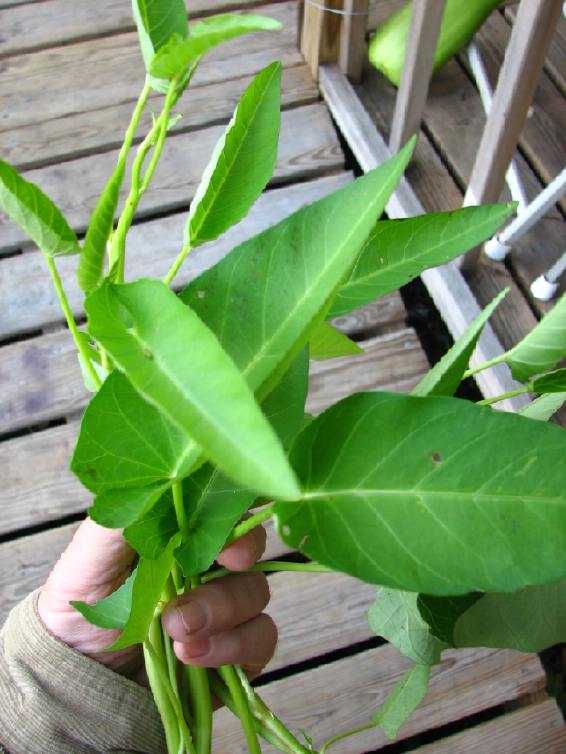

(The initial narrow leaves of Ipomea aquatica widen as the plant matures and gets ready to throw out its runners.)
The photos above show the distinctive pointed leaves and light green color of the water morning glory or water spinach. I first came across the seeds in Iowa of all places, on a seed rack of seeds from Thailand. The yellow cayenne from that same seed rack is still growing in my garden, the water spinach- struggled that first year and I figured it was just not the right environment for it.
This past summer I planted seeds again and like before, they germinated and slowly grew and then at about a foot tall they didn't do anything- at least I didn't think they were doing much. All of a sudden, in early August I noticed the distinctive leaves in my lawn and traced the vines 10 feet or so back to that little bush and then I followed another vine into my squash patch and another into the tomatoes. My gosh, I thought to myself, it's taken over. Sure enough, in the 90 degree days and the slow and steady drip of my t-tape, the water spinach was rooting at each node and then sending new branches in all directions. It was remarkable growth which had to be several inches a day.
I began to pick bunches of the leafy, hollow stems to chop up into half inch pieces and then stir fry with garlic and olive oil, salt and pepper. What an excellent vegetable. Much better than spinach. Very pleasant, tender and without any trace of the oxalic acid taste that makes spinach low on the best veggies list of most folks. The more I tossed it into my frying pan, the more I appreciated it's mild flavor that depends on seasonings for character. No wonder it's the most popular "green" in southeast Asia.
Because it has the potential to become an invasive plant in some areas of Florida and the Gulf Coast, it is a restrictive import that now requires a permit from USDA in order to obtain the seeds. |