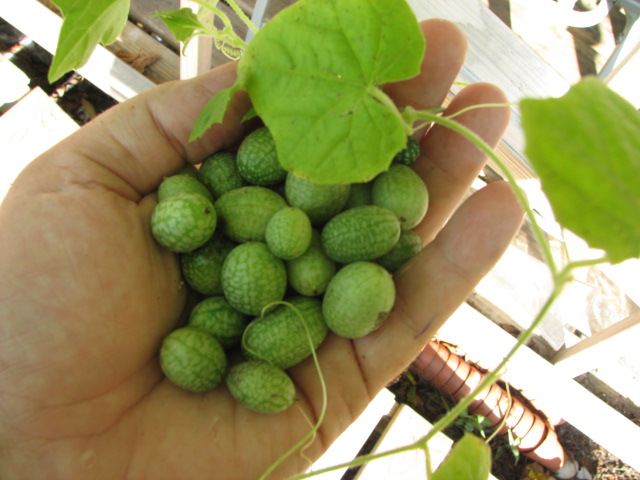
(Melothria scabra, I presume (above)
Commonly called the Mexican sour gherkin, these distant cousins of the cucumber are showing up in seed catalogs as a kind of oddity. We got seeds of these from a European source some years ago, but it would certainly be interesting if we could track down a source in central america where they apparently grow wild. I would like to see what kind of diversity there might be in the native population. You see, that's where there is the greatest genetic diversity, the biggest gene pool. And for a crop like the sour gherkin, I don't believe there's been much, if any, selection by plant breeders. The sour gherkin in commerce probably represents the seed of perhaps only one fruit that has made it's way among collectors and botanists as a curiosity.
The smooth skin, spotted sour gherkins are produced on tiny, delicate vines which ramble with caution through the blades of grass and grabbing stems of other weeds with their active tendrils. When the fruit matures at about a half inch in size, it drops to the ground which makes harvesting fairly easy.
I like the fruit when they are the size of a small grape and before they drop, when they are crunchy little morsels that add a nice texture to salads. These and little cherry tomatoes and a bit of oil and vinegar would be fine. The flavor is like a cucumber complete with that bitterness people are always talking about in older cucumber varieties. The sour or bitter (some people say both) is in the skin and it hits you only after you've been chewing them a while but it's less pronounced if you pick the fruit before they fall.
If there was a larger gene pool with some degree of variation, it would be possible to select traits such as less bitterness and that would be nice.
Italian Melon-Cucumber (Fuzzy Cucumber)

This is the fuzzy melon-cucumber Cucumis melo from Italy which is indeed a bit fuzzy when immature. It is a pleasant enough cucumber that can be used in any way that you would use a regular cucumber. It is sweet, crisp and pleasant through and through. When it matures though, it loses it's fuzz and develops into a rather poor quality melon which has a bit of orange around the seed cavity. There are quite a few cultivars of this kind of melon-cuke known in Italy and they have different shapes and coloration. I'm still trying to figure why I grow them. Actually, these and the closely related Armenian Cucumbers. I'll let you know after another gardening year.
Tomatillos

The Mexican Tomatillo is an interesting plant to grow because of it's useful fruit and, in many cases, attractive plant habit. Some may say the plant is weedy, but I like it's style. It branches and rambles, not a bush and not a vine. I've seen it thread through the open branches of a tree until it towers above my head, but I know it also, to spill over the earth as a low mound of green. I like the chinese lantern -like green calyxes, like little balloons, which are often borne in great abundance.

(The common large green tomatillo is usually used raw in salsas and also cooked into green sauces.)
Part of liseed's Tomatillo Harvest, 2005

Physalis ixocarpa and Physalis philadelphica
This year, besides the common green tomatillo that we use in salsa, we grew a wild "landrace" which is sometimes used by natives of the southwest U.S., turned out to be very drought tolerant and produced a profusion of tiny, dark green fruits which had a pronounced tomatillo flavor. Our favorite though, was a medium sized yellowish tomatillo which is mild and sweet. The flavor is really outstanding.
Martynia proboscidea


Martynia, the unicorn plant, bird plant or devil's claw is a native of the American southwest. When it is small, the young green pod can be eaten, the preferred way, as a pickle. I imagine almost anything could be eaten- pickled. I haven't consumed these. When mature, the exocarp falls off to reveal a tough capsule-like pod that splits into two separating sharp prongs. Navajo's use the pod's fiber as decorative strands in their woven baskets. The dried pod is a wonderful adaptation for seed dispersal. Large animals walking into a patch of martynia get snagged by the pods that clasp onto their legs. The animals try to shake the pods off their ankles and inadvertently shake the seeds out all over the countryside.
As a kid, I sent a couple of first class postage stamps to the Mervon Seed Company (I can't remember if that is the spelling), I believe the company was located in Norwalk, CT. For those stamps, I received seeds of the Shoo-fly plant (which reseeds every year), Vine Peach (arg), Yard Long Beans (they were the tiny red seeded kind), a Palm and Garden Huckleberry (the seeds were stained blue by the fruit unlike any garden huckleberry available today). These were the first seeds I ever received through the mail. What an amazing catalog, the Mervon Seed Catalog was, it was full of descriptions of these botanical wonders I could not imagine ever existing. After saving up my allowance, my parents allowed me to place an order for the seed of the Unicorn Plant. It was a domesticated, black seeded variety which thrived in my garden spreading several feet across during the summer and producing loads of trumpet shaped purple flowers and relatively small black pods before frost. I was pleased to find several white seeded varieties and landraces in the Native Seed Search (Tuscon, AZ) catalog but not the little black seeded variety.
I haven't ever been able to find out much about the Mervon company but I'm intrigued to learn more about those folks who amassed such a strange collection of seeds for sale through the 1950's and excited my imagination.
Ground Cherry (Physalis sp.)


Our strain of Ground Cherry has reseeded here at Flanders Bay Farm for years from an original planting of ground cherries from a half dozen or so sources and it may have crossed with our wild ground cherry. I think that our's is naturalized from Europe (by way of South America originally) although we have some native North American species as well. One of our farmstand customers from Eastern Europe says this is the one she remembers grew wild there and that they used for preserves, jams and pies. The plants are large and sprawling, up to 2 feet high and 3 feet wide. Because it takes them awhile for the seeds to sprout in the summer, they tend to be fall bearers. The fruit, when ripe (calyx turns brown and the fruit becomes orange) falls to the ground and they can be scooped up in quantities enough to make a pie or two. I don't know how to explain the flavor, maybe pineapple like, most of the plants bear very sweet fruit which is nice to snack on but there is some variation in fruit quality.
West Indies Gherkin (Cucumis anguria)

Another cucumber cousin, the West Indies Gherkin (Cucumis anguria). According to historians at Colonial Williamsburg (Virginia), the gherkin descends from the African Cucumis longipes and was introduced to the West Indies, probably with the Portuguese slave trade, from Angola. It has commonly been called the "West Indies Gherkin", due to the mistaken belief, dating to at least the 18th century, that the West Indies was its place of origin. These prickly cukes are about 2 inches long (a giant among the diminutive sour gherkin) and have a small following among pickle enthusiasts.
Lycopersicon pimpinellifolium (Current tomato)

The world's tiniest tomato has got to be Alberto's Shattering Currant! Alberto Vasquez was an early member of the Seed Savers Exchange (as I was) and he wrote that he wanted seeds of Rat-Tail Radish. Well, I was just back from the NOFA Summer Conference where there was a guy selling seed of the Rat-Tail Radish out of a sack. I think he got the seeds from India. I bought a couple of tablespoons of seed. This must have been around 1980. I grew the seeds in the greenhouse at the college where I worked. The seed pods were truly like a rat's tail (unlike some rat-tails sold today), over a foot long, pencil thin and mostly deep purple in color. Very impressive. But that's another story. Alberto would trade me seeds of his current tomato for rat-tail seeds. Done.
Alberto had two types of current tomatoes, one that shattered it's fruit (drops to the ground when ripe) and another that holds the fruit. He sent me the seed of both and I grew large seed crops. I sold both types for many years and companies who got the seed from me also sold the two kinds for a while. I've noted though that the one that drops it's fruit isn't in commerce anymore.
Why, people ask me, would you want a current tomato that drops it's fruit? Why indeed! The labor involved with picking current tomatoes for market is considerable. We developed a technique though, of planting the shattering current tomatoes on mounds with landscape cloth sloping downward from the base of the plants. Shake the bushes every couple of days and scoop up the tomatoes that roll down to the base of the cloth. So simple.
Why current tomatoes at all? What these tiny pea sized tomatoes lack in flavor they make up in texture. They're just great providing that bit of crunch as a salad garnishing. They've been a favorite ever since Alberto shared his wonderful seeds with me.