Italian Melon-Cucumber(Fuzzy Cucumber)
This is the fuzzy melon-cucumber Cucumis melo from Italy which is indeed a bit fuzzy when immature. It is a pleasent enough fruit that can be used in any way that you would use a regular cucumber. It is crisp and pleasant through and through when it is young. When it matures though, it loses it's fuzz and develops into a rather poor quality melon which sometimes has a bit of orange around the seed cavity and if you were to use it as a cuke, you would scoop the seeds out first. I guess you could develop a sweet cucumber to use when it is mature but I would probably be thinking this is a bad melon all the time I was eating it-so, it might not work. There are quite a few cultivars of this kind of melon-cuke known in Italy and they have different shapes and coloration. These melon cukes and closely related Armenian Cucumbers are novel additions to any garden or farmstand. Compared to the Armenian Cukes these are less productive outdoors, although with fertile warm greenhouse conditions, like the Armenian, they might excel. We grew the variety, Carosello Barese.
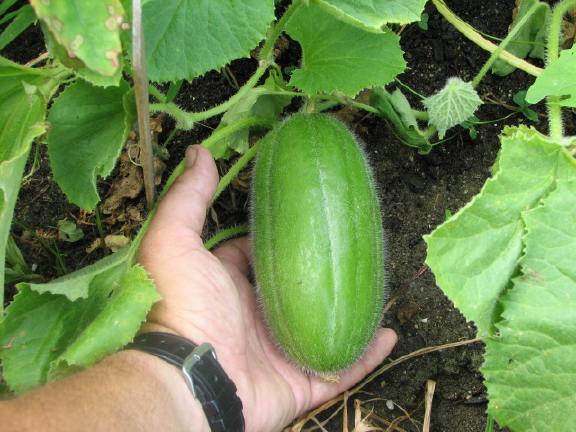
(The mature melon-cuke looks more and more like a melon.)
We did grow some Armenian Cucumbers which are nice slicing cucumbers. They are crisp, thin-skinned, and mild-flavored. Again, they tend to do best under very fertile, very warm conditions and there are a few different varieties available. The most common Armenian is the one marketed as the Snake Cucumber which is a very pale green- almost white, slightly ribbed and coils a bit even when trellised.
(Melothria scabra, I presume (below)

Commonly called the Mexican sour gherkin, these distant cousins of the cucumber are showing up in seed catalogs as a kind of oddity. We got seeds of these from a European source some years ago, but it would certainly be interesting if we could track down a source in central america where they apparently grow wild. I would like to see what kind of diversity there might be in the native population. You see, that's where there is the greatest genetic diversity, the biggest gene pool. And for a crop like the sour gherkin, I don't believe there's been much, if any, selection by plant breeders. The sour gherkin in commerce probably represents the seed of perhaps only one fruit that has made it's way among collectors and botanists as a curiosity.
The smooth skin, spotted sour gherkins are produced on tiny, delicate vines which ramble with caution through the blades of grass and grabbing stems of other weeds with their active tendrils. When the fruit matures at about a half inch in size, it drops to the ground which makes harvesting fairly easy.
I like the fruit when they are the size of a small grape and before they drop, when they are crunchy little morsels that add a nice texture to salads. These and little cherry tomatoes and a bit of oil and vinegar would be fine. The flavor is like a cucumber complete with that bitterness people are always talking about in older cucumber varieties. The sour or bitter (some people say both) is in the skin and it hits you only after you've been chewing them a while but it's less pronounced if you pick the fruit before they fall.
If there was a larger gene pool with some degree of variation, it would be possible to select traits such as less bitterness and that would be nice.
West Indies Gherkin (Cucumis anguria)
Another cucmber cousin, the West Indies Gherkin (Cucumis anguria). According to historians at Colonial Williamsburg (Virginia), the gherkin descends from the African Cucumis longipes and was introduced to the West Indies, probably with the Portuguese slave trade, from Angola. It has commonly been called the "West Indies Gherkin", due to the mistaken belief, dating to at least the 18th century, that the West Indies was its place of origin. These prickly looking cukes (actually the prickles are soft) are about 2 inches long (a giant among the diminuative sour gherkin) and have a small following among pickle enthusiests.

|