About Broccoli Seed Production
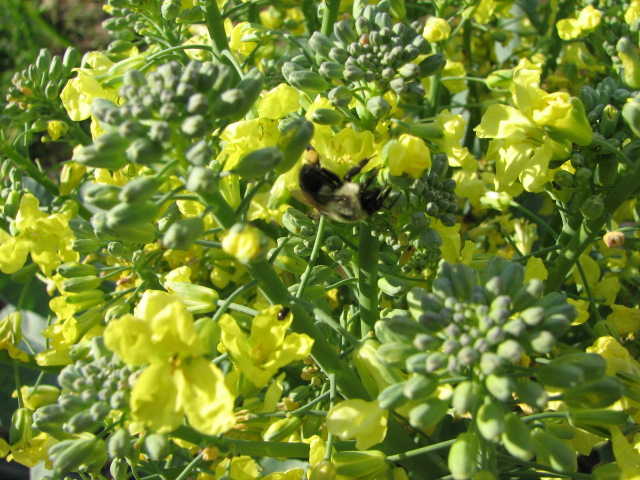
(Above- Broccoli begins to flower)
Once broccoli starts to flower, it bolts quickly and attracts many kinds of insect pollinators. We get an equal number of bumble bee and honey bees working the flowers as well as flies and cabbage butterflies. I'm ready for the cabbage butterfly larvae with dipel dust but so far no sign of those pesky green caterpillars. Rarely, broccoli can self-pollinate but mostly it doesn't. Sometimes pollination is hit or miss and seed production can be erratic. Pollen will generally have to be transferred among several plants. This self-incompatibility seems to facilitate chance hybrids that show greater vigor.
Pollinating insects do get around (they can travel and move pollen around over many hundreds, perhaps thousands of feet) and if other members of the broccoli species is in flower at the same time, they will be crossed. Cabbage, cauliflower, kohlrabi, some kinds of kale, brussels sprouts are some members of the B. tolerance spp. Breeders have crossed broccoli with cauliflower with some interesting and marketable developments, but for the most part you will probably want to grow only one of the B. tolerance species at a time, and only one cultivar if you want to maintain seed purity
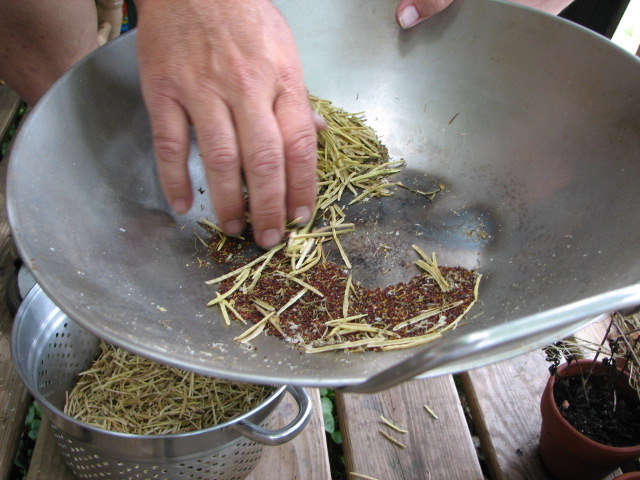
Pollinated flowers develop siliques or seedpods on elongating flower stalks. When most of the pods enlarge with seeds and turn brown pull up the plant, roots and all, and allow the plant to dry in a well ventilated area until it's pods are brittle. Cut off the roots and the thrash the stalks (roll the seed pods back and forth through your hands until the sides of the pods break free and seed is released. Use a strainer or screen to separate seed from pod remains. Finally, gently blow away fine debris with a fan to leave the clean seed behind. For small-scale seed production, good quality broccoli seed is fairly easy to produce on the farm. When I was in the seed business I always hot water treated my brassica seed before packing; 122° F for 25 minutes, cooled and quickly blown dry (without heat on screens) just to make sure that I wasn't going to distribute any seed-borne disease. I never do that for my own seed and I haven't had any major disease problems. So you decide.
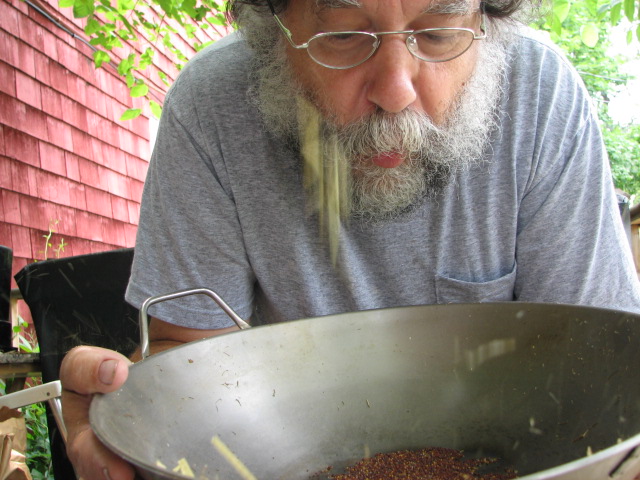
(I guess I could have used a fan or my air compressor to winnow out the chaff and produce clean seed. But for small batches- why bother?)
Initial Results of the OSU Broccoli Project at Flanders Bay Farm
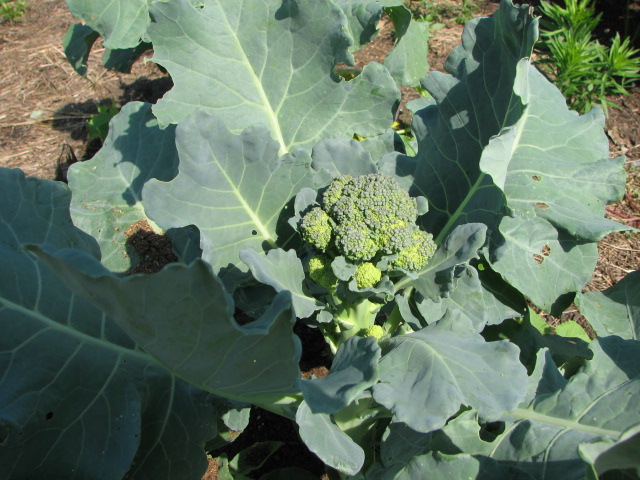
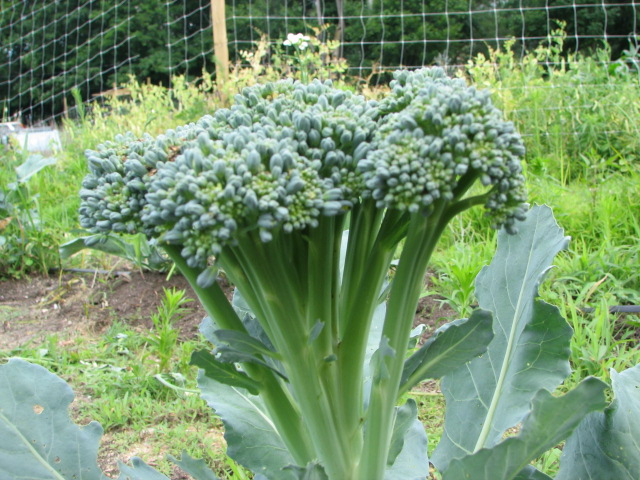
Approximately 20% of the OSU Broccoli plants began to produce early heads about 55 days after setting them out in the field. Because of the stress of several days of 90° F temperatures during this time period, they didn't hold their tight heads for long although these early broccoli could have been marketed over a 2-3 day window before the head loosened and the buds began to flower. Broccoli is a cool weather crop and on Long Island is more often sown in late summer to mature in the cool fall weather. High temperatures interfere with broccoli's holding ability. At optimum harvest time head quality was very good (in spite of the heat). Some of the heads had stems extended well above the foliage which is an interesting trait that makes the heads easy to harvest (no leaves to strip off) and is easy to make attractive bunches in 3's.
Because I liked the early heading extended stem trait, I transplanted those plants exhibiting the trait to another more isolated section of the garden so that they could cross with each other as a separate population. Otherwise those traits would be diluted with the pollen from the other plants. I don't attempt to hand-pollinate broccoli flowers because I have a large population of pollinating insects and can accomplish the same end result by isolating plants. If care is taken in removing a large enough root ball, broccoli can transplant well even when mature. Vegetative (non-heading) side sprouts can also be selected from plants of your choice and can be rooted with some ease to increase production of especially good plant selections.
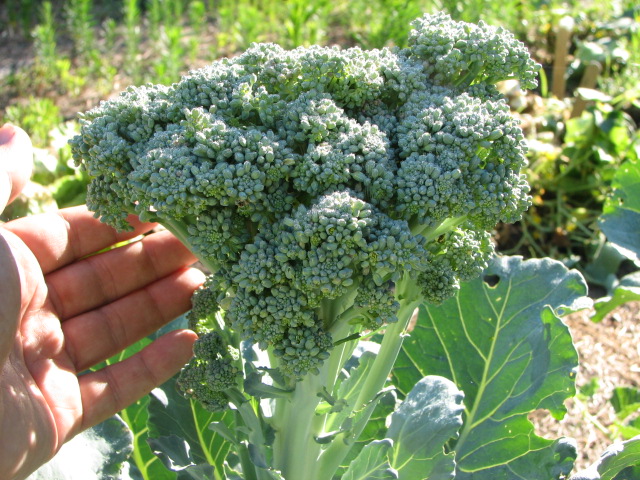
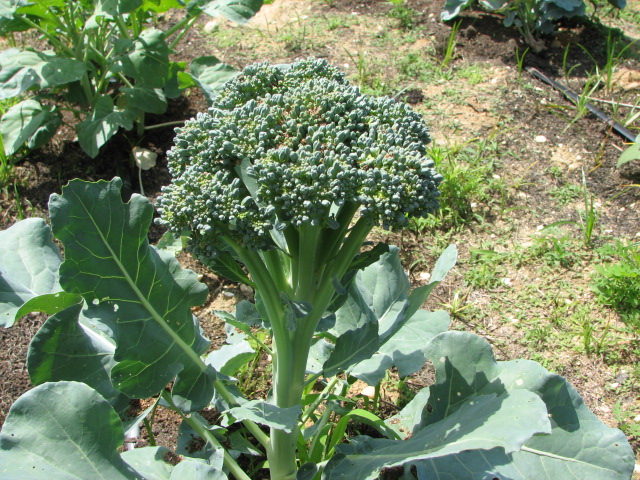
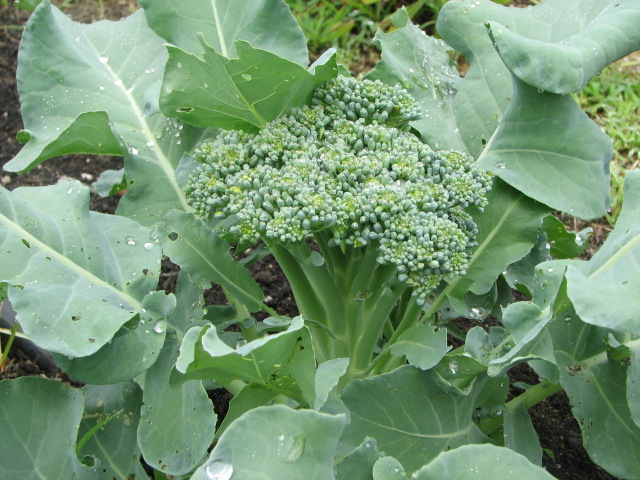
(One of the most recent OSU Broccoli heads to be produced. They are indeed getting bigger!)

Zak is hilling up OSU broccoli with organic compost, the plants were raised in the greenhouse for four weeks and then transplanted into the garden in mid May. They received side-dressings of bone meal, dried chicken manure and dolomitic limestone. Broccoli plants are spaced 16" apart in rows 3 feet apart. Note the T-tape for drip irrigation.
Breeding a Better Broccoli
In April, 2005 we received a sample of broccoli seed from Elizabeth Dyck, NOFA-NY's project coordinator of the Organic Seed Partnership. It was part of a larger sample of seed from Oregon State University's open-pollinated broccoli breeding project (which is overseen by OSU plant breeder, James Myers) being distributed to organic farmers for on-farm selection and the eventual development of a cultivar adapted to organic growing systems. The broccoli was originally was the result of a mass cross of hybrid and open pollinated varieties made at OSU. This large gene pool would hopefully provide traits such as disease and pest resistance, vigor, good flavor and suitability to marketing by small-scale growers and organic farmers.
This innovative project is one of the first to involve organic farmers in the actual development of a cultivar well-suited to organic growing systems. Organic farmers in the U.S. Northwest and the U.S. Northeast will be growing the OSU broccoli gene pool and then rogue out the poor performers and save the seed of the best performers. This seed is returned by the organic farmers back to OSU to be redistributed again to more organic farmers. I believe that we received seed that has already gone through some initial selection on organic farms.
Early Head Diversity in OSU Broccoli
OSU Broccoli seed germination was erratic with only about 50% viability and several percent obviously growth-impaired seedings which left me with a smaller population of plants than I would have liked. All plants were transplanted into the field. During the first week a few plants were taken by cut worms (collars quickly made out of newspaper stopped the larvae) and later a few plants scattered among the planting mysteriously wilted and died. These plants had a damaged root system with very little root growth. Other than those problems the plants have remained healthy and surprisingly free of pests.
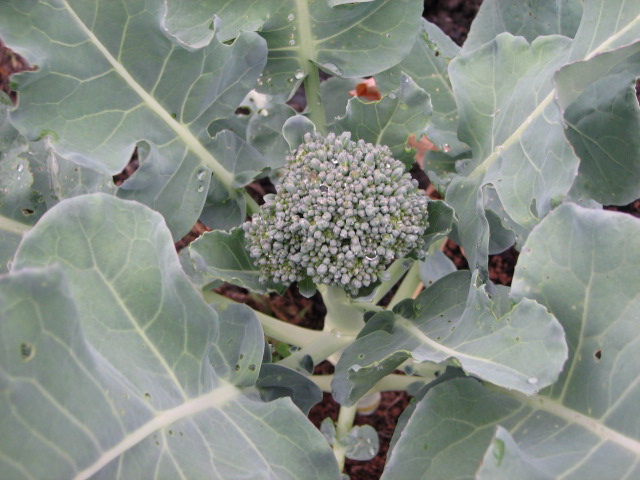
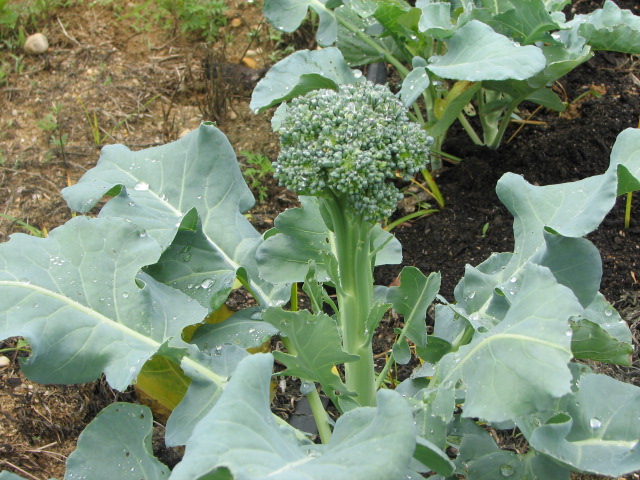
There is a lot of diversity in the OSU seed. See photos of just the early heading kinds. At this writing (July 10) only half the plants have headed! There is nothing not to like about the OSU broccoli so far. Head size on these early plants is usually more than 2.5 inches and with better soil fertility and wider spacing, I would expect an increase in size. The plants are growing in a field where top soil was stripped off to sand and gravel only a year ago and is just in the process of being rebuilt.
By the looks of it, they will mature over a rather large time range and as long as they fall into various plant growth habits, I will continue to separate groups into isolated breeding populations. Those that have done poorly under my system of gardening are already gone. Plants that produce an unmarketable product will be rouged. Selection, both natural (environmentally induced) and at my hand (as I decide what qualities I want in broccoli) is plant breeding at it's simplest. Next year this broccoli will be an even better performer on my farm than this year. That's how it goes when farmers and university breeders collaborate!
Home Grown "Broccolini" Project
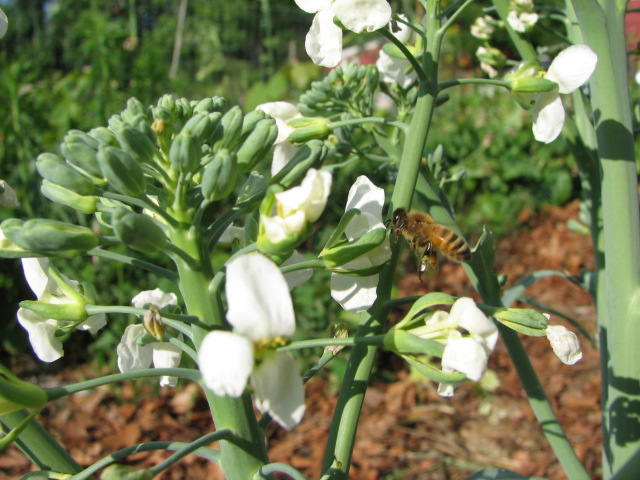
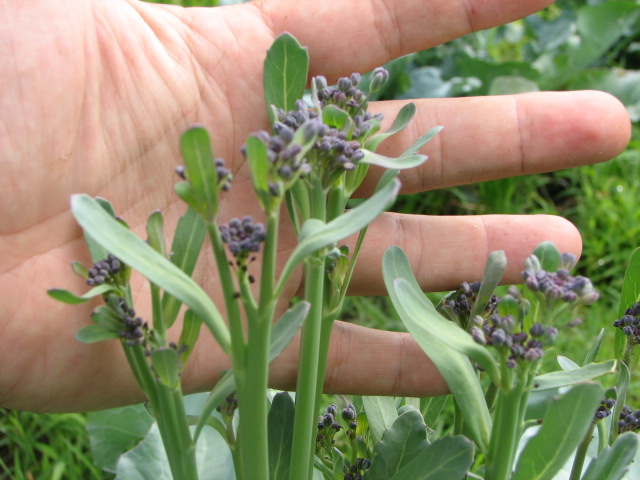
(Gai Lon Stalks (top), and in flower (middle), An odd annual purple sprouting broccoli that produces white flowers (bottom)
Have you heard of Broccolini or Asparagus Broccoli? Maybe. Have you seen it in a gourmet market? Maybe. Have you grown it for your customers? Definitely Not. Broccolini was developed by Sakata Seed Company, the seed is produced under contract by a Thailand Company and in the U.S. it can only be grown by a California Packing Company that has an exclusive contract. Broccolini is a hybrid between a cultivar of Gai Lon (or Kailan), a white flowered brassica sometimes known as Chinese Kale (Brassica oleracea var. alboglabra) and a selection of standard broccoli. We've been growing those Gai Lon cultivars available looking for tender, brittle stems and a mild, sweet flavor. This year we've interplanted our selections of Gai Lon with a rather loose headed broccoli selection and hope that the bees will help to cross the two. We'll also hand pollinate using "bee sticks" (dead bees glued onto wood coffee stirrers) since they are more effective than Q-tips or paint brushes in transferring pollen.
|
|